January 31, 2007

January 2007 Digest

The Renewable Industrial Revolution

After more than 150 years, the Industrial Revolution is overdue for a major retooling. No longer can we heedlessly combust biomass and fossil resources without consideration for the carbon emissions and potential energy that "floats out the smokestack." But what can possibly replace the status quo paradigm that we have based so much of our energy, industry, transportation, and lifestyle liberties upon?

This BIO "BlogRing" - BIOstock Blog, BIOconversion Blog, BIOoutput Blog, and the new BIOwaste Blog - is intended to help identify the multi-faceted pieces of emerging biomass technologies. - is intended to help identify the multi-faceted pieces of emerging biomass technologies. Like a Rubik's cube, the parts are inextricably linked together, but currently in disarray. By addressing each facet independently, challenging issues will become clear. By shifting perspective, new collaborative solutions can be synthesized. Not just one solution but many, because the ultimate solution for any market will depend upon the resources, ecology, and stakeholders of that market.

Here are their most significant developments of January 2007, organized by blog...

BIOstock Blog--------------
Utilizing Pine Beetle Wood Waste as BIOstock
Japanese wood-to-ethanol facility uses Arkenol process
CHINA: Choosing wood over corn for biofuels production
Low heat gasification converts woody biostock to energy
25x'25 Vision of BIOstock Supply
Food vs. Fuel: Over-reliance on Corn Raises Ag Prices
Celunol produces Ethanol from Wood using Bacteria
BIOethanol converted from pulping liquor
Food vs. Fuel? U.S. Farmers Can Produce Both
Black Liquor Gasification Technology Attracts Volvo Investment

BIOconversion Blog--------------
Biomass: Year-in-Review
Biomass Power Generation using Gasification
ALT Energy Stocks: The Future of Ethanol
FLORIDA: Cultivating a Bioconversion Industry
Low heat gasification technique to convert biostock to energy
Europe's "New Industrial Revolution"
Celunol launches commercial-scale cellulosic ethanol plant in Japan
Cellulose Ethanol Market Potential Report
ACORE: President Bush on Renewable Energy in 2007
Apollo Alliance pursues 'green-collar' jobs
Ethanol and Net Energy - EROI
The Renewable Path to Energy Security

BIOoutput Blog-----------------
FAQ: BIOoutput Blog
"Living with Ed" Begley, Jr. in Studio City
CALIFORNIA: Governor Targets Fuel Emissions
Electric cars - a boost for biofuels?
CHINA: Pollution threatens 2008 Olympics
BioButanol from Cellulosic Bioconversion
From Food to Fuel to Fashion

NEW! BIOwaste Blog-----------------
FAQ: BIOwaste Blog
Spinning “Gold” Out of Trash
Southern California Emerging Waste Technologies Forum
The Benefits of Conversion Technologies
Recycling’s “China Syndrome”
Plasma Gasification and Incineration Compared
CANADA: Municipal Solid Waste Disposal Options
CHINA: Pollution threatens 2008 Olympics
Using Algae to Recycle Flue Gas into Biofuels
U.S. D.O.E.: Strategies for Reducing Greenhouse Gases
CALIFORNIA: Air Resources Board tackles Global Warming
Impact of Global Growth on Carbon Emissions
Enforcing California's Greenhouse Gas Emissions Limits
BIOwaste Energy as Explained on the Energy Kid's Page
Expanded Recycling - a Key to Cutting Fossil Fuels and Global Warming
Mayors seek $4B to fight Energy & Environmental Challenges
MIT/PNNL Plasma Arc Waste-to-ethanol Solution

Each month we provide a similar breakdown of article titles from our favorite "companion" site - Biopact Blog. This list is kept current and is accessible in the right hand column of each of the three blogs.

Please forward a link to this digest to anyone you know who would be interested in keeping track of change that will affect us all. They can add their name to the mailing list on the BioConversion Blog.


technorati , , , , , ,

January 30, 2007

MIT/PNNL Plasma Arc Waste-to-ethanol Solution

Plasma arc systems represent the very high heat end of the gasification technology scale generating temperatures at 1,000°C and above to vaporize feedstock into gaseous form. The hotter the fire, the broader the range of odious feedstocks that can be cleanly converted into syngas.

It generally takes about 160 megawatts per hour to feed the energy needs of the plasma arc from which can be derived about 600 megawatts of electricity.

An article about a MIT and Integrated Environmental Technologies collaboration to perfect and deploy the technology was recently written up in Technology Review magazine.

----------------
Liquid fuel from common trash: new technology converts municipal waste into ethanol

A new conversion technology takes organic items otherwise headed for the landfill and turns them into usable fuel. The double-punch effect of this technology comes from the fact that it vaporizes organic material, releasing a mixture of hydrogen and carbon monoxide, which can be synthesized to create other gasses and chemicals. To be used as fuel, the synthesized gas would be converted to ethanol and methanol.

The originators of this technology are the Massachusetts Institute of Technology and Batelle Pacific Northwest National Labs of Richland, Wash. The technology is now being commercialized by a spin-off of PNNL named Integrated Environmental Technologies, also from Richland, that already works in the waste-to-energy business.

One scientist told the magazine Technology Review that if this conversion process becomes widely available, it could reduce America’s dependence on foreign oil for fuel.

Daniel Cohn, a cofounder of IET and a senior research scientist at the MIT Plasma Science and Fusion Center, told Technology Review that with the amount of municipal and industrial waste created in the United States, the new fuels could “replace as much as a quarter of the gasoline used in this country,” the magazine reported.

The process to create ethanol can be used not only for municipal waste, but also agricultural biomass waste. This means that it has the potential to create ethanol without relying on corn plants, which is a large part of how ethanol fuel is currently produced. By using municipal, industrial and agricultural waste instead of an agricultural crop, in theory it is a more reliable source of material.


technorati , , , , , ,

January 28, 2007

Mayors seek $4B to fight Energy & Environmental Challenges


In view of the front burner status granted to energy independence, the mayors of the nation have issued calls upon the federal government to insure that climate protection does not become "a poor stepchild." After all, the two are related.

At a recent meeting, the mayors have called for $4 billion in an Energy and Environmental Blog Grant to help cities combat global warming. In addition to mitigation of automobile emissions, steps need to be taken to reduce waste that goes into landfills - a major source of greenhouse gases - and cut emissions from non-renewable electric power generation. Educating urban populations through government-sponsored outreach programs would also be a warranted expense.

----------------
US Mayors Call for $4 Billion Block Grant to Combat Global Warming
Cities are on the frontlines of climate change with mayors leading the way. But we can’t do it alone. We need the federal government to be a real partner with us on the issues of climate protection and achieving energy independence. That is why we are proposing an Energy and Environmental Block Grant.
—Douglas H. Palmer, Conference President and Trenton, NJ Mayor

The block grant would provide funding directly to cities and urban counties for programs that: improve community energy efficiency; reduce carbon emissions; and decrease dependence on oil.

To date, more than 372 mayors from all 50 states, plus the District of Columbia, have signed onto the US Mayors Climate Protection Agreement, led by Seattle Mayor Greg Nickels, where mayors have pledged to take actions to cut their emissions in line with the Kyoto Protocols. Additionally, the Conference of Mayors has held two national energy summits focused on alternative fuel sources and green buildings.

The mayors also outlined three requests of the 110th Congress:
• Establish a national cap on greenhouse gas emissions and a flexible market-based system of tradable allowances for emitting industries;
• Pass climate-friendly energy and transportation policies; create funding and incentives to help cities in their efforts to curb emissions; and
• Create funding and incentives to help cities in their effort to curb emissions.


technorati , , , , , , ,

January 26, 2007

Expanded Recycling - a Key to Cutting Fossil Fuels and Global Warming

What is "expanded recycling?"

To governmental agencies and utilities "expanded recycling" means changing regulations so we can move more trash from the black bin into the blue bin... or making more pre-sorted pickups available from multi-family dwellings (apartment buildings and condos). Some (Californian's Against Wastes and other environmental groups) see it as reducing the source of waste - reducing packaging while manufacturing products out of more biodegradable and recyclable materials. To them it also means holding manufacturers accountable for recovering their spent products and reusing their components. Certainly "expanded recycling" is all of these.

But to a growing legion of waste management professionals expanded recycling can also be achieved through biomass conversion technologies (CTs). According to their preferred waste management hierarchy, after the source of waste has been reduced and reused, and as much of the trash has been recycled and composted as possible, the bulk of the residual should be recycled molecularly using clean conversion technologies.

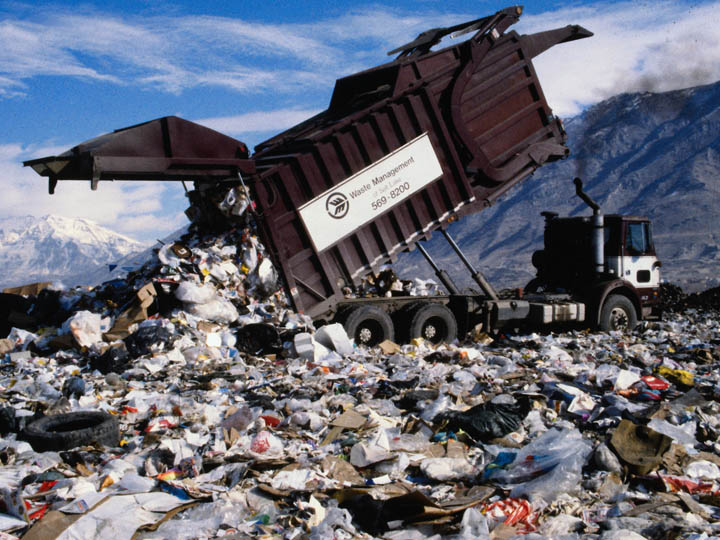
How big is this mountain of residuals? In spite of our best efforts at recycling, it is as big as it was when recycling started back decades ago - roughly 40 million tons per year in California. Why?... because of population growth and expanded consumption of packaged goods. Since most of these goods are imports, reducing or redesigning the source of waste is an unreal expectation without draconian change in consumer behavior and trade regulations.

Isn't halting growth good enough? No - because the only "ultimate" solution now is landfills and they are filling up fast. Los Angeles Co. Department of Sanitations' gargantuan landfill in Puente Hills (13,200 tons per day or approximately 65% of their responsibility) will run out of room within seven years. Their backup site is 200 miles away. That means using a new expensive "waste-by-rail" train system to ship the residuals to the desert. That will require the equivalent of a 3-mile long train each day!

So time is running out. Currently under evaluation for deployment of a new CT facility by the Los Angeles Department of Public Works are a number of suppliers - one supplier using anaerobic digestion, two using waste-to-fuel technology, and six using thermal technology. Using various clean biological and thermal processes they seek to recycle as much as 85% of the residual waste volume by converting it into its molecular components and reforming them into synthesis gas, sugars and oils, low sulfer diesel, and "green" chemicals.

The synthesis gas (primarily CO and H2) could be combusted - but a cleaner more cost-effective alternative would be to ferment it into ethanol or reap the hydrogen - the cleaner air renewable fuel alternatives for ending gasoline dependence. The thermal technologies would also provide a clean alternative source of steam for co-generating electricity.

What relevance is "expanded recycling" to global warming and California's AB32? Landfills reek methane (21 times more toxic than C02 as a greenhouse gas) and although modern landfills capture much of this gas, they have been identified as one of the principal targets of the carbon cap legislation. Other major targets are electrical power plants, oil refineries, and utilities. By using conversion technologies, positive emissions impacts can be made on all of these - fewer fossil fuel burning power plants; less dependence on high-polluting oil and oil refining process; more reliance on cleaner fuel vehicles and hybrids; fewer landfills and cleaner wastewater and solid waste disposal. A side benefit - the use of noisy, polluting trucks and trains to haul trash from sorting centers to landfills will be cut by an estimated 60%.

The utilities - mostly LA/Department of Public Works and LA/Department of Sanitation - need public understanding and support for their efforts to permit and deploy conversion technologies. These people are heroes in my book because in an age of increasing media exploited cynicism they are in the background valiantly solving problems. Warrantless legal battles with local communities and idealists puts a counter-productive strain on problem-solving. These problems are real and their social costs are mounting.

The status quo is the real enemy. We, the public and its media, need to support "our soldiers" on the front line - the utilities.


technorati , , , , , , , , , ,

January 22, 2007

BIOwaste Energy as Explained on the Energy Kid's Page

The U.S. Department of Energy has an educational service operated by its Energy Information Agency. Since most adults are a lost cause, they have a spritely and simply written lesson site called the "Energy Kid's Page". If you are a science teacher of any age, you might want to direct your students to this reference site. If you want to bone up on how far educators will have to go to turn novices into decisionmakers you might also want to take a gander.

The Energy Kid's Page is, of course, hundreds of pages long. It contains energy facts, history, games, a glossary, and classroom activities. It also has a handy Energy Calculator with common units and conversions.

Here's a sample:
If you bury these items in a landfill, how long would it take them to decompose?
Diaper: 500-600 years,
Cotton Sock: 5-6 months,
Styrofoam Cup: 1 million years or more,
Glass Bottle: 1 million years or more,
Leather Belt: 40-50 years,
Wooden Block: 10-20 years,
Banana Peel: 3-4 weeks,
Paper Box: 1-2 months,
Plastic Bottle: 1 million years or more,
Aluminum Can: 200-500 years.

On the subject of Waste-to-Energy plants
Because of our limited exposure to waste-to-energy plants, we have some negative assumptions about the utility and harmful effects that could be possible. Turns out we are way behind the technological curve when it comes to our deployments of clean waste-to-energy facilities:
Many countries have built waste-to-energy plants to capture the energy in their trash. There are more than 600 waste-to-energy plants in 35 different countries. For example, the use of waste-to-energy plants in some European and Asian countries has grown, in part because they have little open space and few energy resources. The U.S. burns 14 percent of its trash in waste-to-energy plants. Denmark, on the other hand, burns 54 percent.

On the subject of Recycling

Some critics of waste-to-energy plants are afraid that burning waste will hamper recycling programs. If everyone sends their trash to a waste-to-energy plant, they say, there will be little incentive to recycle.

Recently, a study of cities that have both recycling programs and waste-to-energy plants showed higher recycling rates than other cities in the U.S. Why would these cities recycle more when they burn their trash? The results showed that people living in cities with waste-to-energy plants are more educated about municipal solid waste and strongly support their recycling programs.

So, while at first glance, recycling and waste-to-energy seem to be at odds, they can actually complement each other. That’s because it makes good sense to recycle some materials, and better sense to burn others.

It is all about the kids after all. They will inherit the legacy we leave them - and will probably pay for it as well. In the meantime, we need to educate them and ourselves if we are going to, in addition, leave a legacy of hope for their children.

------------------


technorati , , , , , , , ,

January 21, 2007

Enforcing California's Greenhouse Gas Emissions Limits

The real, gritty work involved in carrying out what is probably the biggest project in the history of state regulation has begun.
- Daniel Weintraub

Here's a challenge that may put a practical halt to the enforcement of the far-reaching Global Warming Solutions Act of 2006.

The legislators who passed the bill are displeased with how Governor Schwarzenegger intends to bring companies into compliance with its carbon caps. In short, the Democrats and their environmentalist allies want to force companies within each industry to comply across-the-board with the limits contained in the bill.

The Governor, who signed the bill, sees using a carbon credit program as being a more practical way to implement the bill's provisions. Daniel Weintraub of the Sacramento Bee describes it as " a market-based system that allows companies to buy the right to pollute from others who have done more than their share to reduce greenhouse gas emissions. The idea behind such a market is to achieve the desired amount of reduction without crippling a particular industry or company."

It is incumbent upon drafters of the legislation to realize that resistance to change by those who will have to pay for it will ultimately delay its implementation. Imagine the lawsuits that could pit major industries and utilities (electricity generation, oil and gas extraction, oil and gas refineries, cement production and landfills) against the State. They are trying to comply with the provisions of the bill but are prevented from implementing solutions because of failure of the State to reform antiquated regulations and permitting legislation.

The other obvious unintended consequences - companies will leave the state or be force to cut back rather than be faced with fees that will render them uncompetitive within their own industries. Utilities could easily outsource across state borders. These consequences could prove disasterous for California's tax revenues at the state and local level, depressing employment and adversely affecting labor unions. How does that promote the interests of the Democrats political base?

Unless industry-requested regulations and permitting reforms are passed, companies and utilities can effectively argue in court that the California legislature is hamstringing their efforts to deploy solutions to meet the provisions of this bill.

Weintraub has written an excellent article - excerpts are listed below:

------------------
Grit hits the fan on pollution credits
By Daniel Weintraub, Sacramento Bee

California's landmark law to fight global warming by clamping down on greenhouse gas emissions has not even taken effect, and already the Democrats in the Legislature who crafted the bill are at odds with Gov. Arnold Schwarzenegger, who, if he is re-elected Nov. 7, will be responsible for making it work.

Democrats and their environmentalist allies are charging that Schwarzenegger is breaking commitments made during a long summer of negotiations on the bill, AB 32. The governor, they say, is taking steps that could undermine the state's ability to cut greenhouse gases 25 percent by 2020, the bill's ambitious goal.

Schwarzenegger aides counter that the governor is merely trying to position the state's environmental bureaucracy to get a running start implementing the law when it goes into effect Jan. 1.

Behind the confrontation is a fundamental dispute over exactly how California should force its industries to comply with the caps on greenhouse gas emissions as they are phased in during the years ahead.

Democratic lawmakers and most environmental groups want to emphasize state-imposed standards and regulations to limit greenhouse gases.

Industries would be ordered by the Air Resources Board to retool their operations in particular ways to limit the production of carbon dioxide.

Schwarzenegger is not averse to this kind of direct regulation, which opponents characterize as "command and control." But the governor has also insisted that the new regulatory regime include a market-based system that allows companies to buy the right to pollute from others who have done more than their share to reduce greenhouse gas emissions.

The idea behind such a market is to achieve the desired amount of reduction without crippling a particular industry or company.

Now Schwarzenegger has issued an executive order calling on the Air Resources Board, whose members he appoints, to move forward immediately with a market-based system that allows the trading of emissions credits with the European Union and a group of northeastern states that have begun a similar program.

Assembly Speaker Fabian Núñez and Senate Leader Don Perata have objected, saying the bill they passed contemplated emissions trading only after other, more direct measures were taken.

Perata, in a letter to Schwarzenegger, said the order was "ill-timed and unnecessary," and called on the governor to rescind it. But Schwarzenegger's chief of staff, Susan Kennedy, told me in an interview that Schwarzenegger has no intention of backing down.

"The governor is committed to developing a workable cap and trade system that includes market-based incentives," Kennedy said. She added that the two approaches -- direct regulation and the trading of emission credits -- need to be developed into a comprehensive system that offers industry the flexibility it needs to comply in the most cost-effective manner possible.

"This needs to be seamless," she said. "It will be seamless."

This is only the opening skirmish in what promises to be a long and contentious battle over AB 32. The smiles and hugs and bipartisan press conferences that heralded the bill's passage last month are now history. The real, gritty work involved in carrying out what is probably the biggest project in the history of state regulation has begun.


technorati , , , , , , ,

Impact of Global Growth on Carbon Emissions

"Business as usual" could could have serious long-term consequences for global energy consumption and carbon emissions. According to a report released by PriceWaterhouse-Coopers (PwC) last month, global carbon emissions from fossil fuels are going to more than double by the year 2050 unless a number of significant policy changes are enacted soon to deploy technological emission reduction measures.

In March 2006, PwC published a report, The World in 2050: How big will the emerging market economies get and how can the OECD compete?, on the rapid growth of the "E7" emerging economies (China, India, Brazil, Russia, Mexico, India, and Turkey). They project the combined economies of these countries could be 25-75% greater than the G7 countries (U.S., Japan, Germany, UK, France, Italy, Canada) by 2050.

The questions unaddressed by that report - what consequences on global climate will that growth cause? What is the need for change?

These questions are covered in a follow-up study, The World in 2050: implications of global growth for carbon emissions and climate change policy released in September. In it, the author provided a baseline estimate of carbon emissions with the current rate of energy efficiency. He then developed five different scenarios incorporating more successively aggressive measures.

It is a sober look at the paths open to us and the need to start implementation. Our leaders must recognize the need to start deploying clean solutions now and adjust them as we go. Civilization cannot afford to squander decades (as we have since the last big oil crisis) holding out for "ideal" solutions. According to PcW:

The analysis also suggests that there could be significant costs to delay, given the time required to develop and implement the necessary technologies and policies. As emissions from the faster-growing emerging economies will almost certainly continue to rise over the next few decades, the G7 economies may need to take the lead in reducing their carbon emissions.

But this should create major new market opportunities, allowing companies in the established OECD economies to specialise in areas of comparative advantage, while their consumers benefit from low cost imports from the emerging economies — a "win-win" outcome rather than "one winner takes all".

A few excerpts:

-------------------------
The World in 2050: implications of global growth for carbon emissions and climate change policy
Report outlines 'Green Growth Plus' strategy that could curb global carbon emissions without significantly reducing long-term economic growth
John Hawksworth, Head of Macroeconomics, PriceWaterhouse-Coopers

The report considers six possible scenarios but focuses most attention on two key possibilities:

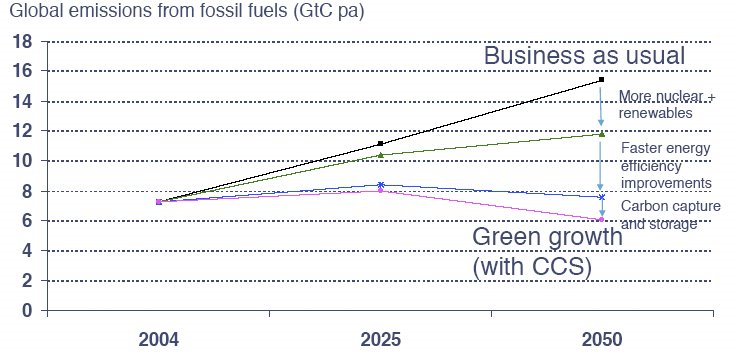
• A baseline scenario in which energy efficiency improves in line with trends of the past 25 years, with no change in fuel mix by country; this ‘business as usual’ scenario acts as a benchmark against which to assess the need for change, rather than as a forecast of the most likely outcome; and
• A scenario called Green Growth + CCS, which incorporates possible emission reductions due to a greener fuel mix, annual energy efficiency gains over and above the historic trend, and widespread use of carbon capture and storage (CCS) technologies. Of the scenarios considered in the report, only this ‘Green Growth Plus’ strategy stabilises atmospheric CO2 concentrations by 2050 at what the current scientific consensus suggests would be broadly acceptable levels.

The chart below shows how it might be possible to get from the baseline scenario to the preferred Green Growth + CCS scenario for global carbon emissions in three steps.

1. A shift to a much less carbon intensive fuel mix through increased nuclear and/or renewables supply (more than doubling the current non-fossil-fuel primary energy share to around 30% by 2050) and reduced fossil fuel.
2. Energy intensity reductions significantly faster than historic trends (2.6% per annum rather than 1.6% per annum, which would reduce carbon emissions in 2050 by around a third relative to our baseline scenario).
3. Significant investment in carbon capture and storage (CCS) technology and capacity of the order of 1.5GtC per annum by 2050, which could reduce carbon emissions by a further 20%, relative to our Green Growth scenario without CCS.

John Hawksworth concludes: "Our analysis suggests that there are technologically feasible and relatively low-cost options for controlling carbon emissions to the atmosphere. Estimates suggest that the level of GDP might be reduced by no more than around 2-3% in 2050 if this strategy was followed, equivalent to sacrificing only around a year of economic growth for the sake of reducing carbon emissions in 2050 by around 60% compared to our baseline scenario".

"But if this is to be achieved, it will take further concerted action by governments, businesses and individuals over a broad range of measures to boost energy efficiency, adopt a greener fuel mix, and introduce carbon capture and storage technologies in power plants and other major industrial facilities".


technorati , , , , , , ,