Showing posts with label report. Show all posts

March 1, 2009

Sierra Club and Worldwatch: Gasification is a "Smart Choice" for Biofuels

In February of this year the Worldwatch Institute and Sierra Club jointly released a report that supports the continued development of cellulosic biofuels using thermochemical means. From the report...
“In the thermochemical platform, heat, pressure, chemical catalysts, and water are used to break down biomass in much the same way that petroleum is refined. Thermochemical technologies include gasification, fast pyrolysis, and hydrothermic processing. These technologies can be used to convert almost any kind of biomass into fuel, from grass to turkey feathers, giving them a potential advantage over biochemical technologies that rely on developing specific enzymes to break down specific plant matter."

Smart Choices for Biofuels maps a future path for biofuels to ensure that they are more environmentally and socially sustainable and that the use of renewable fuels for transportation contributes to the global effort to reduce global warming pollution. The steps proposed in the report include an accelerated transition to cellulosic feedstocks such as switchgrass and the use of more effective agricultural practices to decrease erosion and soil nutrient depletion. Further, the report specifically identifies advanced biofuels feedstocks as including “the organic material found in urban waste."

Here are several other excerpts from the report:
"Despite ambitious government mandates and strong financial support for the biofuels industry, so-called “first-generation” biofuels have raised a variety of economic, social, and environmental concerns. New information points to the urgent need for a major shift to more-advanced biofuels to prevent negative effects on the climate, land, soil, water, air, and rural economies."

"Nearly all studies on the role of biofuels in mitigating global warming and boosting energy security have concluded that “second-generation” (or “advanced”) biofuels, which rely on non-food feedstocks and offer dramatically improved energy and greenhouse gas profiles, are necessary to make wider use of biofuels feasible worldwide."

"Cellulosic and other advanced biofuels have a better fossil energy balance than do first-generation biofuels; that is, the amount of fossil energy required to make the fuel is much lower relative to the amount of energy gained in return, which can significantly lower lifecycle greenhouse gas emissions."

One of the report's major policy recommendations is to:
“Re-examine the renewable energy portfolio balance to bring on cellulosic and other advanced biofuels faster and to promote biomass use for electricity generation and heat."

----------------
technorati , , , ,

November 2, 2007

Capturing energy from unrecycleable waste

Implementing new technologies to solve chronic problems is hard work. A generation filled with expectations of instant gratification is sure to be frustrated by the seemingly slow pace of change to correct obvious environmental challenges.

Take recycling for example. In the last twenty years we have made great strides to reduce, reuse and recycle trash from our waste streams as we hover around 50% diversion from landfills throughout major portions of California. And yet, with the simultaneous growth of volume of trash, we seem unable to reduce beyond that threshold.

Beginning in 2004 the County of Los Angeles engaged in a program to take a major leap forward in reducing the accumulation of seemingly unrecycleable waste that ends up going from county material recovery facilities (MRFs) to landfills. Their vision is to deploy emerging conversion technologies at the MRF that can cleanly reduce trash volume by as much as 85% without emitting toxins or greenhouse gases into the atmosphere. As a substantial bonus, renewable bioenergy could be captured through the generation of green electricity and/or biofuels - depending on which specific technology is chosen.

A team of seasoned experts have just issued an evaluation report of their progress to date. Titled the Los Angeles County Conversion Technology Evaluation Report: Phase II - Assessment it details the thorough screening and evaluation of technologies from throughout the world - Israel, Japan, Europe, and the United States - that are competing for deployment at one of the county's best suited MRFs.

In recognition of the public's interest in the program's operations and environmental sustainability, public outreach programs and state regulatory reform efforts are already underway. A decision on the final site and technology to be funded will be made in early 2008. In view of the environmental costs of doing nothing and the painstaking efforts the Department of Public Works and allied agencies are making to deploy a solution that is in the best interest of all stakeholders, the decision by the parties involved in this effort is certain to be one that deserves public support.

Below is the latest (October 31, 2007) press release on the report.

------------------------------
COUNTY OF LOS ANGELES RELEASES FINDINGS ON NEW ALTERNATIVES TO LANDFILLS
County report finds viable conversion technologies to tackle Southern California's looming trash problem

Los Angeles - 36,000 tons per day! That's how much trash is deposited into landfills on a daily basis from Los Angeles County. Within a few short years, many of those landfills will be reaching capacity. This includes the Puente Hills Landfill, currently the largest operating landfill in the United States, which will close in 2013. That leaves Los Angeles with one very large problem.

After years of exhaustive research and evaluation of conversion technology facilities from around the world, the County of Los Angeles has announced the official release of a report summarizing its findings and outlining the next steps in its conversion technology program. In the next year, the County will select one or more projects to be among the first commercial-scale demonstration facilities in the United States, laying the groundwork for a fundamental shift in how the region deals with its garbage.

"Los Angeles County is promoting cutting edge technologies that have been proven effective in Japan, Israel and Europe. Trash doesn't have to be a problem, it can be a resource for clean energy and other marketable products," stated Paul Alva, chair of the County's Alternative Technology Advisory Subcommittee.

Conversion technologies encompass a variety of advanced processes that convert normal household trash into renewable energy, biofuels and useful products. These technologies provide an alternative to landfills by offering a clean and safe way to turn residual trash (which cannot be recycled economically) into a valuable resource.

"Through first hand evaluations of operational facilities in Europe, Israel, and Japan, we have found that conversion technologies are viable and environmentally friendly means of managing our solid waste," said Alva. "These technologies offer real solutions to California's waste and energy crises."

The report identifies four viable technologies that are capable of managing Southern California's residual waste in a cost-effective and environmentally sound manner. In addition, the report identifies four recycling facilities where a conversion technology facility could be co-located. The County will request that these "short-listed" technology developers and recycling facilities form partnerships and submit formal proposals to be among the first commercial-scale conversion technology demonstration facilities in the United States. Early next year, a competitive bid process will determine which project will receive the County's support. A final decision will be announced by mid-2008.

The technology finalists are: Arrow Ecology (anaerobic digestion); International Environmental Solutions (pyrolysis); Interstate Waste Technologies (gasification); and Ntech Environmental (gasification). The site finalists are: Del Norte Regional Recycling and Transfer Station (Oxnard); Perris MRF/Transfer Station (Perris); Rainbow Disposal (Huntington Beach); and Robert A. Nelson Transfer Station and MRF (Rubidoux).

In conjunction with the report's release, the County has launched a new and improved conversion technology Web site. The www.SoCalConversion.org.

The mission of the Southern California Conversion Technology Demonstration Project is to evaluate and promote the most promising conversion technologies from around the globe, and work with communities throughout the region to develop demonstration facilities that showcase the technical, economic and environmental viability and benefits of conversion technologies.

----------------
technorati , , , , , , , ,

January 21, 2007

Impact of Global Growth on Carbon Emissions

"Business as usual" could could have serious long-term consequences for global energy consumption and carbon emissions. According to a report released by PriceWaterhouse-Coopers (PwC) last month, global carbon emissions from fossil fuels are going to more than double by the year 2050 unless a number of significant policy changes are enacted soon to deploy technological emission reduction measures.

In March 2006, PwC published a report, The World in 2050: How big will the emerging market economies get and how can the OECD compete?, on the rapid growth of the "E7" emerging economies (China, India, Brazil, Russia, Mexico, India, and Turkey). They project the combined economies of these countries could be 25-75% greater than the G7 countries (U.S., Japan, Germany, UK, France, Italy, Canada) by 2050.

The questions unaddressed by that report - what consequences on global climate will that growth cause? What is the need for change?

These questions are covered in a follow-up study, The World in 2050: implications of global growth for carbon emissions and climate change policy released in September. In it, the author provided a baseline estimate of carbon emissions with the current rate of energy efficiency. He then developed five different scenarios incorporating more successively aggressive measures.

It is a sober look at the paths open to us and the need to start implementation. Our leaders must recognize the need to start deploying clean solutions now and adjust them as we go. Civilization cannot afford to squander decades (as we have since the last big oil crisis) holding out for "ideal" solutions. According to PcW:

The analysis also suggests that there could be significant costs to delay, given the time required to develop and implement the necessary technologies and policies. As emissions from the faster-growing emerging economies will almost certainly continue to rise over the next few decades, the G7 economies may need to take the lead in reducing their carbon emissions.

But this should create major new market opportunities, allowing companies in the established OECD economies to specialise in areas of comparative advantage, while their consumers benefit from low cost imports from the emerging economies — a "win-win" outcome rather than "one winner takes all".

A few excerpts:

-------------------------
The World in 2050: implications of global growth for carbon emissions and climate change policy
Report outlines 'Green Growth Plus' strategy that could curb global carbon emissions without significantly reducing long-term economic growth
John Hawksworth, Head of Macroeconomics, PriceWaterhouse-Coopers

The report considers six possible scenarios but focuses most attention on two key possibilities:

• A baseline scenario in which energy efficiency improves in line with trends of the past 25 years, with no change in fuel mix by country; this ‘business as usual’ scenario acts as a benchmark against which to assess the need for change, rather than as a forecast of the most likely outcome; and
• A scenario called Green Growth + CCS, which incorporates possible emission reductions due to a greener fuel mix, annual energy efficiency gains over and above the historic trend, and widespread use of carbon capture and storage (CCS) technologies. Of the scenarios considered in the report, only this ‘Green Growth Plus’ strategy stabilises atmospheric CO2 concentrations by 2050 at what the current scientific consensus suggests would be broadly acceptable levels.

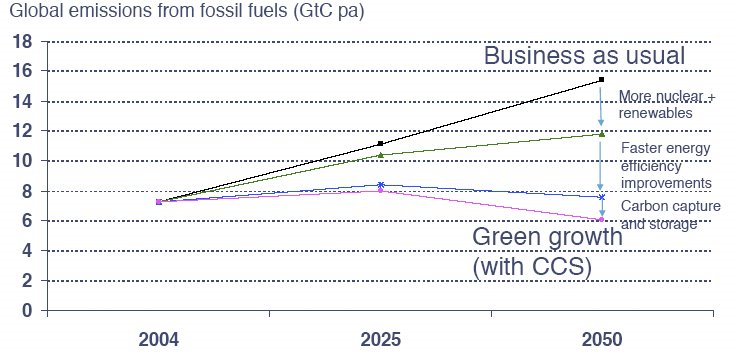
The chart below shows how it might be possible to get from the baseline scenario to the preferred Green Growth + CCS scenario for global carbon emissions in three steps.

1. A shift to a much less carbon intensive fuel mix through increased nuclear and/or renewables supply (more than doubling the current non-fossil-fuel primary energy share to around 30% by 2050) and reduced fossil fuel.
2. Energy intensity reductions significantly faster than historic trends (2.6% per annum rather than 1.6% per annum, which would reduce carbon emissions in 2050 by around a third relative to our baseline scenario).
3. Significant investment in carbon capture and storage (CCS) technology and capacity of the order of 1.5GtC per annum by 2050, which could reduce carbon emissions by a further 20%, relative to our Green Growth scenario without CCS.

John Hawksworth concludes: "Our analysis suggests that there are technologically feasible and relatively low-cost options for controlling carbon emissions to the atmosphere. Estimates suggest that the level of GDP might be reduced by no more than around 2-3% in 2050 if this strategy was followed, equivalent to sacrificing only around a year of economic growth for the sake of reducing carbon emissions in 2050 by around 60% compared to our baseline scenario".

"But if this is to be achieved, it will take further concerted action by governments, businesses and individuals over a broad range of measures to boost energy efficiency, adopt a greener fuel mix, and introduce carbon capture and storage technologies in power plants and other major industrial facilities".


technorati , , , , , , ,

U.S. D.O.E.: Strategies for Reducing Greenhouse Gases

On September 21st the U.S. Department of Energy released their Climate Change Technology Program (CCTP) Strategic Plan which describes broadscope measures that the D.O.E. should pursue to reduce greenhouse gas emissions. The publication of the study confirms that the U.S. Department of Energy considers "climate change" to be a pressing issue:

As a party to the United Nations Framework Convention on Climate Change (UNFCCC), the United States shares with many other countries the UNFCCC’s ultimate objective, that is, the “…stabilization of greenhouse gas concentrations in Earth’s atmosphere at a level that would prevent dangerous anthropogenic interference with the climate system . . . within a time-frame sufficient to allow ecosystems to adapt naturally to climate change, to ensure that food production is not threatened, and to enable economic development to proceed in a sustainable manner.” Meeting this objective will require a sustained, long-term commitment by all nations over many generations.


Technologies emphasized for development are hydrogen extraction, biorefining, renewable power generation, clean coal and carbon sequestration, nuclear fission and fusion. Of these, biomass conversion is applicable to all but nuclear fission and fusion.

Below are some excerpts that relate specifically to biomass conversion and syngas technologies:

-----------------
U.S. Climate Change Technology Program Strategic Plan
September 2006

The Plan sets six complementary goals:

1 - Reducing emissions from energy use and infrastructure;
2 - Reducing emissions from energy supply;
3 - Capturing and sequestering carbon dioxide;
4 - Reducing emissions of other greenhouse gases;
5 - Measuring and monitoring emissions; and
6 - Bolstering the contributions of basic science to climate change.

These six CCTP strategic goals focus primarily on mitigating GHG emissions to make progress toward stabilizing atmospheric GHG concentrations. They are not intended to encompass the broad array of technical challenges and opportunities that may arise from climate change.
—CCTP Strategic Plan

A recent assessment of potential biofuel resources concluded that by mid-21st century it would be technically possible to produce enough biomass to displace about one-third of current petroleum consumption. The study made no conclusions about economic feasibility. This level of biofuel production would require economically-competitive technologies to convert cellulosic biomass (rather than just the sugars and starches) into ethanol, and developing cellulosic ethanol technologies is a central aspect of the Biofuels Initiative and the President’s Advanced Energy Initiative.

◆ Biochemical Conversion of Biomass. Research is required to gain a better understanding of genomes, proteins, and their functions; the enzymes used for hydrolyzing pretreated biomass into fermentable sugars; the micro-organisms used in fermentation; and new tools of discovery such as bio-informatics, high-throughput screening of biodiversity, directed enzyme development and evolution, and gene shuffling. Research must focus on improving the cost, yield, and equipment reliability for harvesting, collecting, and transporting biomass; pretreating biomass before conversion; lowering the cost of the genetically engineered cellulose enzymes needed to hydrolyze biomass; developing and improving fermentation organisms; and developing integrated processing applicable to a large, continuous-production commercial facility.

◆ Thermochemical Conversion of Biomass. Research is needed to improve the production, preparation, and handling of biomass; improve the operational reliability of thermochemical biorefineries; remove contaminants from synthesis gas and develop cost-competitive catalysts and processes for converting synthesis gases to chemicals, fuels, or electricity. All processes in the entire conversion system must be integrated to maximize efficiency and reduce costs.


technorati , , , , , , , ,

January 20, 2007

CANADA: Municipal Solid Waste Disposal Options

A search for a current comparison of waste disposal options uncovered this report by the Recycling Council of Alberta Canada. It describes in considerable detail the various waste treatment options available for typical municipalities of 20,000, 80,000, and 200,000 inhabitants.

----------------------------

MSW Options: Integrating Organics Management and Residual Treatment/Disposal
Recycling Council of Alberta, April 2006

Municipal Solid Waste (MSW) Options: Integrating Organics Management and Residual Treatment/Disposal will assist municipalities in moving their integrated waste management systems to the “next level” in order to further conserve resources, reduce environmental impacts, reduce greenhouse gas emissions, produce energy, lessen dependence on landfills and improve social acceptability.

The report provides evaluations of the following Organics Management and Residual Treatment/Disposal options:
• composting;
• anaerobic digestion;
• sanitary landfill.
• bioreactor landfill; and
• thermal treatment including incineration, gasification, pyrolysis, and plasma arc.

The indicators used in the evaluations included: environmental, social, economic, energy and greenhouse gases.

Here is a simple animation showing how Consutech incinerators use heat in a double chamber configuration to reduce the mass of the input feedstock.


technorati , , , , , , , ,

The Benefits of Conversion Technologies


The Los Angeles City Council hired URS Corporation to make a study, HEALTH IMPACTS OF CONVERSION TECHNOLOGIES IN CALIFORNIA, to identify technologies that would help it reach its landfill diversion goals through conversion technologies. That study was released late last year.

A followup story written by Mr. Predpall has appeared in a recent issue of MSW Management magazine. Within its content is a well-written summary of the benefits of CTs (see below). I have also included his identification of the California opposition to them - which concurs with mine. I highly recommend reading the entire article.

--------------------

The Time Has Come for Conversion Technologies
by Dan Predpall, V.P. of URS Corp.

The benefits offered by CTs have not been publicized well. The benefits of CTs will be brought into public awareness as entities such as the city of Los Angeles and the county of Los Angeles continue to pursue development of CTs as a way to manage disposal of their residual MSW streams.

The key benefits of CTs are:

Increased Recycling. This benefit is not well recognized. The CTs under development today are being designed to process residuals from materials recovery facilities (MRFs) or trash (residuals after source separation).

These residuals still contain considerable amounts of recyclable materials that can be recovered in pre-processing. In addition, materials produced by the conversion units, such as slag and bottom ash, can be recycled. Some question why the operator would want to remove the recyclables from the input stream. The answer is simple: The facility will earn greater revenues by recycling additional metals, glass, and paper than it will by processing this material in the conversion unit, typically with a loss in overall efficiency. Further, “unrecyclable” plastics that would otherwise go to a landfill are excellent feedstocks for CTs.

Generation Of Renewable Energy. Processing MSW residuals to generate energy or green fuels qualifies in most states as a source of renewable energy. In addition, processing MSW to energy qualifies as a renewable energy under Renewable Portfolio Standards and can be used to create renewable energy credits in some states. If about one-third of the residential MSW collected annually in the city of Los Angeles were processed by CTs, about 50 MW of renewable energy could be produced.

Reduced Landfill Impacts. The byproducts created by CTs are typically very small in quantity, and inert. Therefore, the material that cannot be recycled in a CT and must be sent to a landfill will not result in impacts to the environment. The situation is quite different when MSW (or MSW residuals) are landfilled. Even modern landfills impact the environment via release of methane (a greenhouse gas) not captured by landfill gas collection, air emissions from equipment operating the landfill, and leakage through failures of landfill liners.

Offsets To Fossil Fuel Usage. CTs can generate electricity or green fuels by processing MSW. This in turn reduces the amount of fossil fuels needed to supply the energy requirement of a region. Energy savings result when the entire life cycle of the MSW collection and processing system is evaluated, and all of the energy usage and energy production and recycling benefits are considered.

The energy savings can be significant. For example, according to the California Integrated Waste Management BoardÂ’s (CIWMB) CT report to the legislature, energy savings in the Los Angeles region could be equivalent to a 150 MW power plant (this assumes treating about one-third of the total residential MSW collected annually in the City of Los Angeles).

Lower Air Emissions. The use of CTs can result in reductions in emissions of NOx, SOx, and particulates. For example, NOx emissions, which are precursors of smog, acid deposition, and reduced visibility, are primarily the result of fuel combustion processes. Through the use of CTs, NOx emissions can be avoided by displacing combustion activities and electricity production and increasing the recycling of materials.

Using similar data and assumptions as noted above, the NOx emissions avoided by building CTs in Los Angeles would be equivalent to those emitted from a 1,000-MW, gas-fired power plant.

Reduced Carbon Emissions. Carbon emissions contribute to the greenhouse effect, and, therefore, can lead to climate change. Carbon emissions result from the combustion of fossil fuels and the degradation of organics. Methane emissions from landfills represent a significant source of carbon emissions, since methane has a global warming potential about 21 times that of CO2. The use of CTs can create offsets for carbon emissions through increased recycling, diversion of organics from landfills, and displacement of fossil fuels.

Based upon data in the CIWMB report to the legislature, processing about one-third of the residential MSW collected annually in Los Angeles would reduce carbon emissions by about 1,000,000 metric tons per year.

The overall benefit of CTs is that of increased environmental sustainability. In general, environmental sustainability involves a number of issues, including:

• Reliance on renewable energy
• Improving environmental quality
• Reducing waste
• Conserving natural resources
• Responsible consumption
• Long-term focus

Therefore, the use of CTs closely complies with the goals of environmental sustainability.

Opposition.

As more CT projects are being proposed, opposition from specific groups is growing. One is the global environmental organization that opposes mass-burn incineration. This group has typically opposed CT implementation on the grounds that CTs are actually “incinerators in disguise”. This is untrue; in fact, there are many significant technological differences between CTs and mass-burn incinerators. Another opposition group is the recycling industry. This industry sees CTs as a threat to its business because it claims that CTs will process all MSW, including recyclables. As mentioned above, this is unlikely because, A.) projects under development are using MSW residuals, and B.) the value of residuals as a recycled material is higher than its value for CT processing.

-------------------

The Los Angeles Bureau of Sanitation just released a detailed assessment of conversion technologies, which can be found at Evaluation of Alternative Solid Waste Processing Technologies .


technorati , , , , , , ,

Green Jobs for America: Two Reports

As we near the break point of our oil dependency, a new vision for America's energy future is emerging. Two recently released reports focus on the employment implications of an invigorated changeover from fossil fuels to renewable fuels and green energy systems. New industries will emerge from this transition. Old skill-sets will be applied in new ways. As energy production decentralizes to exploit the myriad feedstocks and generation technologies that will develop, high value jobs will be created.

Writer/blogger Joel Makower wrote an article for Clean Edge Technologies that lists a number of regionalized reports on the green employment picture for America. He mentions Apollo Alliance, a highly visible an experienced coalition of labor and environmental groups, in his editorial and their Ten-Point Plan for Good Jobs and Energy Independence (summarized below). Coincidentally, I met Apollo Alliance President Jerome Ringo at the Biomass Coordinating Council meeting at the Power-Gen Conference in Las Vegas last week. As part of the "Apollo Initiative" his group has just published a comprehensive report called New Energy For America: Apollo Jobs Report which identifies job opportunities that will raise America's energy infrastructure while providing a broad range of economic and environmental benefits to the world.

Excerpts from Joel's editorial and each of the two reports are listed below:

----------------------


Clean Technology: Where the Jobs Are
by Joel Makower

Over the past few years, a succession of cities, counties, regions, and states have sought to brand themselves as the "Silicon Valley" of clean technology, or some such moniker. About 18 months ago, Clean Edge prepared a strategy for the city of San Francisco (along with a subsequent progress report) on how to make that city a clean-tech magnet. Other studies have show the potential for clean energy and related technologies to create jobs in Arizona, New Mexico, New York, the Midwest U.S., the Northwest U.S. (PDF), and America as a whole.

Comes now the City of Angels, heralding "green technology" (in its parlance) as the new job-creation machine for Southern California. According to Jobs in L.A.'s Green Technology Sector, released recently by the Economic Roundtable,

"Los Angeles has unrealized opportunities to become a growing provider of 'green' goods and services, and through this growth to create decent jobs that benefit all residents of the city."


The Los Angeles study is noteworthy for the level of detail it offers, and for the broad occupational territory it covers.

----------------------

Excerpts from the Report, prepared for the Department of Water and Power and the Workforce Investment Board of the City of Los Angeles by the ECONOMIC ROUNDTABLE.

Jobs in L.A.'s Green Technology Sector, 2006

Los Angeles has unrealized opportunities to become a growing provider of “green” goods and services, and through this growth to create decent jobs that benefit all residents of the city. To realize these opportunities Los Angeles has to make up lost ground because, compared to the U.S. economy, it has a below-average share of jobs in every significant green technology industry. Strengths that Los Angeles can build on include:
  • A large diverse economy with significant strengths in many green technology
    industries.
  • Ambitious environmental goals and the need for innovative technologies to
    achieve those goals.
  • A growing consumer market for green products and services.
  • Significant public sector requirements for green products and services.
  • Exceptional intellectual assets in local universities and research institutions.


  • Key Policy Questions
    Can the business establishments that generate green products and services, as well as the manufacturers and service providers that supply them, expand in Los Angeles to create good paying jobs that benefit local residents equitably? The answer to this broad question rests on answers to several smaller questions:
    • How many businesses with environmentally linked activities already operate in
    the L.A. region?
    • Is the green technology sector expanding?
    • How many of their suppliers are locate here?
    • Which suppliers benefit most from growth in this industry?
    • What types of jobs does the green technology sector provide?
    • What types of skills are necessary to work in this sector?
    • Can entry-level workers find job opportunities in this sector?


    ----------------------


    New Energy For America: Apollo Jobs Report
    from the Apollo Alliance

    The new Apollo Initiative calls for a large scale federal commitment, on the scale of $30 billion/year for 10 years, to achieve a new energy infrastructure that is diversified, environmentally safe, and more efficient. This initiative will turn challenge into opportunity. It will generate good jobs and help US companies capture the green markets of the future. It will reduce dependence on foreign oil. It will rebuild communities, and it will make America an environmental leader again, helping put the world on a path to a sustainable future.

    The new Apollo Initiative will achieve these benefits by pursuing four broad strategies:

  • Diversify our energy sources: making America less dependent on foreign oil, while making energy more secure, more affordable and reliable, and less polluting
  • Invest in the industries of the future: promoting new technology, improving manufacturing processes, and expanding markets for American durable goods.
  • Promote construction of high performance, energy efficient buildings: saving money and rebuilding more livable, more equitable, and healthier environments, and
  • Drive investment in cities and communities: renewing our commitment to building smart public infrastructure for transportation, energy, and other vital public services.


  • Taken together, these strategies combined with national commitment, public investment, meaningful standards, and political will, can bring about enormous benefits for both America and the world.

    And remarkably, by creating jobs and economic growth, this investment will generate sufficient new returns to the US treasury from increased income, to pay for itself over a ten year period.

    The Ten-Point Plan for Good Jobs and Energy Independence

    1. Promote Advanced Technology & Hybrid Cars
    2. Invest In More Efficient Factories
    3. Encourage High Performance Building
    4. Increase Use of Energy Efficient Appliances
    5. Modernize Electrical Infrastructure
    6. Expand Renewable Energy Development
    7. Improve Transportation Options
    8. Reinvest In Smart Urban Growth
    9. Plan For A Hydrogen Future
    10. Preserve Regulatory Protections


    technorati