"Business as usual" could could have serious long-term consequences for global energy consumption and carbon emissions. According to a report released by PriceWaterhouse-Coopers (PwC) last month, global carbon emissions from fossil fuels are going to more than double by the year 2050 unless a number of significant policy changes are enacted soon to deploy technological emission reduction measures.
In March 2006, PwC published a report, The World in 2050: How big will the emerging market economies get and how can the OECD compete?, on the rapid growth of the "E7" emerging economies (China, India, Brazil, Russia, Mexico, India, and Turkey). They project the combined economies of these countries could be 25-75% greater than the G7 countries (U.S., Japan, Germany, UK, France, Italy, Canada) by 2050.
The questions unaddressed by that report - what consequences on global climate will that growth cause? What is the need for change?
These questions are covered in a follow-up study, The World in 2050: implications of global growth for carbon emissions and climate change policy released in September. In it, the author provided a baseline estimate of carbon emissions with the current rate of energy efficiency. He then developed five different scenarios incorporating more successively aggressive measures.
It is a sober look at the paths open to us and the need to start implementation. Our leaders must recognize the need to start deploying clean solutions now and adjust them as we go. Civilization cannot afford to squander decades (as we have since the last big oil crisis) holding out for "ideal" solutions. According to PcW:
The analysis also suggests that there could be significant costs to delay, given the time required to develop and implement the necessary technologies and policies. As emissions from the faster-growing emerging economies will almost certainly continue to rise over the next few decades, the G7 economies may need to take the lead in reducing their carbon emissions.
But this should create major new market opportunities, allowing companies in the established OECD economies to specialise in areas of comparative advantage, while their consumers benefit from low cost imports from the emerging economies — a "win-win" outcome rather than "one winner takes all".
A few excerpts:
-------------------------
The World in 2050: implications of global growth for carbon emissions and climate change policy
Report outlines 'Green Growth Plus' strategy that could curb global carbon emissions without significantly reducing long-term economic growth
John Hawksworth, Head of Macroeconomics, PriceWaterhouse-Coopers
The report considers six possible scenarios but focuses most attention on two key possibilities:
• A baseline scenario in which energy efficiency improves in line with trends of the past 25 years, with no change in fuel mix by country; this ‘business as usual’ scenario acts as a benchmark against which to assess the need for change, rather than as a forecast of the most likely outcome; and
• A scenario called Green Growth + CCS, which incorporates possible emission reductions due to a greener fuel mix, annual energy efficiency gains over and above the historic trend, and widespread use of carbon capture and storage (CCS) technologies. Of the scenarios considered in the report, only this ‘Green Growth Plus’ strategy stabilises atmospheric CO2 concentrations by 2050 at what the current scientific consensus suggests would be broadly acceptable levels.
The chart below shows how it might be possible to get from the baseline scenario to the preferred Green Growth + CCS scenario for global carbon emissions in three steps.
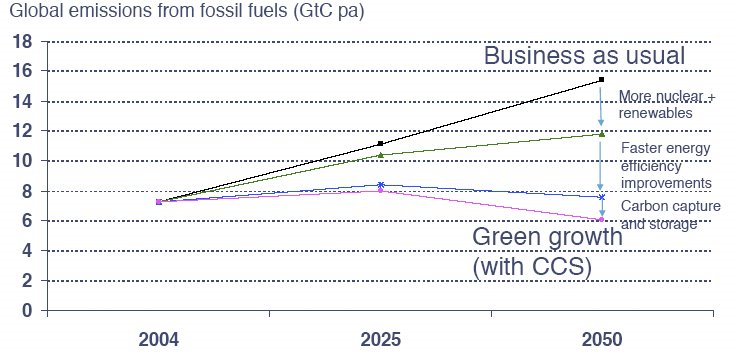
1. A shift to a much less carbon intensive fuel mix through increased nuclear and/or renewables supply (more than doubling the current non-fossil-fuel primary energy share to around 30% by 2050) and reduced fossil fuel.
2. Energy intensity reductions significantly faster than historic trends (2.6% per annum rather than 1.6% per annum, which would reduce carbon emissions in 2050 by around a third relative to our baseline scenario).
3. Significant investment in carbon capture and storage (CCS) technology and capacity of the order of 1.5GtC per annum by 2050, which could reduce carbon emissions by a further 20%, relative to our Green Growth scenario without CCS.
John Hawksworth concludes: "Our analysis suggests that there are technologically feasible and relatively low-cost options for controlling carbon emissions to the atmosphere. Estimates suggest that the level of GDP might be reduced by no more than around 2-3% in 2050 if this strategy was followed, equivalent to sacrificing only around a year of economic growth for the sake of reducing carbon emissions in 2050 by around 60% compared to our baseline scenario".
"But if this is to be achieved, it will take further concerted action by governments, businesses and individuals over a broad range of measures to boost energy efficiency, adopt a greener fuel mix, and introduce carbon capture and storage technologies in power plants and other major industrial facilities".
technorati greenhouse, emissions, policy, global warming, bioenergy, environment, carbon, sequestration